What Drives the Price of a Professional Christmas Light Display
Lit Up Taylor's Way • September 18, 2026 • 8 min read
The question we hear most often, usually before anyone has looked at the house, is "how much is it." The honest answer is that it depends on the house, and the useful answer is to explain exactly what it depends on. Once you know what moves the number, you can walk around your own property and get a fair sense of where you will land before a designer ever arrives.
Full service displays start at $899. Here is what carries a house from there.
Roofline: how many feet, and how many turns
The single biggest driver is the length of roofline you light. A run of custom fit warm white along the eaves is measured in feet, and a long ranch with a garage has more of them than a compact two story. Every foot is bulbs, wire, clips and time on a ladder.
Turns matter almost as much as length. A gable is two angled runs that meet at a peak, and every peak, dormer and change of direction is a place where a strand has to be cut, fitted and clipped precisely. A house with six gables and three dormers is more work per foot than a plain hip roof of the same length, and it also looks better lit, which is the trade. Interesting rooflines cost more and pay you back in the result.
Height: one story or two
Roofline on a single story home is reached from a ladder with both feet on the ground. Roofline on a two story home, or a tall gable over a garage, means taller ladders, more repositioning, more time and more care. Anything the crew has to walk on a pitched roof to reach is slower still, because it has to be done safely. The price reflects that time, and it is the part of the job that most clearly justifies not doing it yourself.
Trees: how many, how big, and how fully
A wrapped tree is the second largest line on most quotes and the one with the widest range.
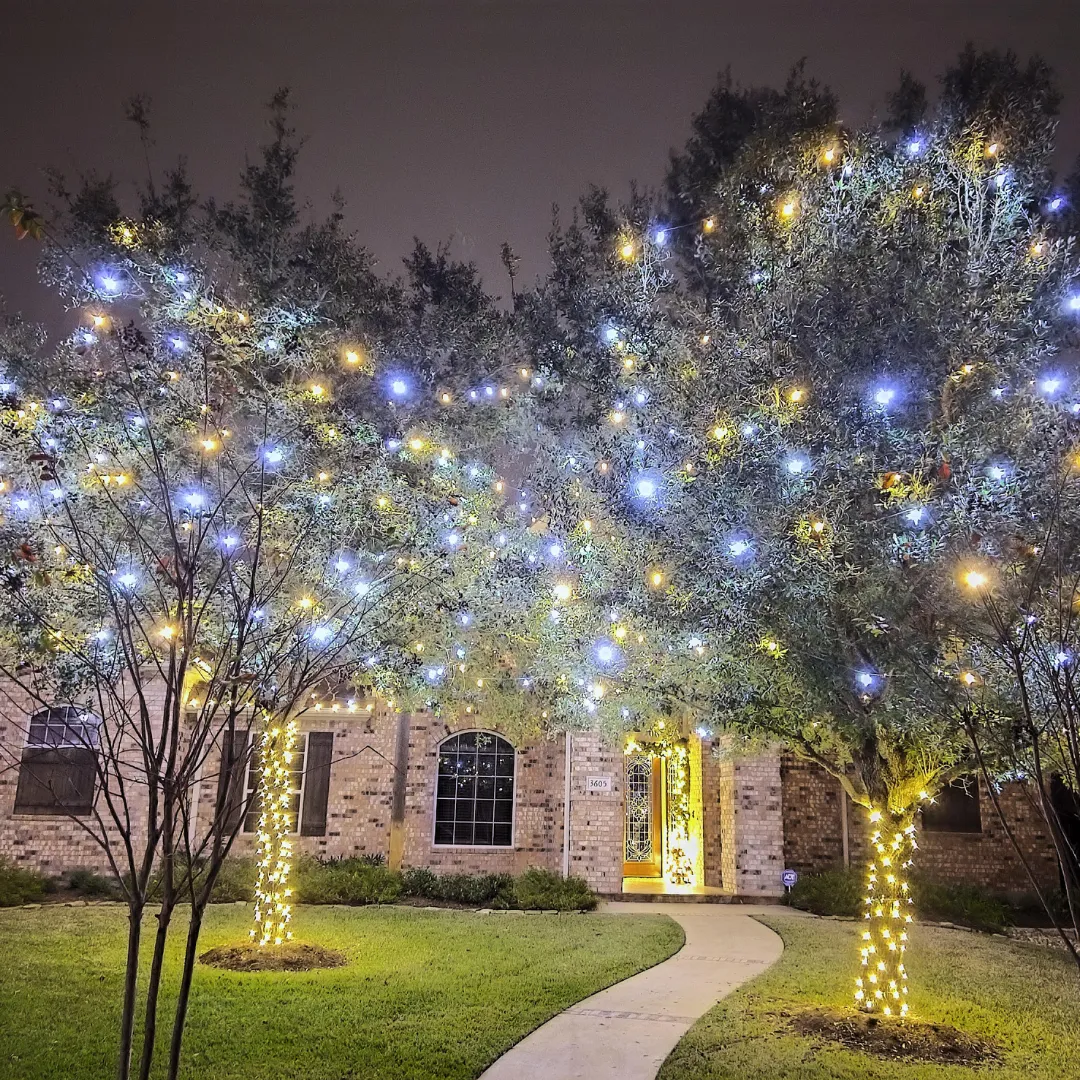
A trunk wrap on a small ornamental tree is a modest job. A trunk wrap and lower canopy on a mature tree is more. A full canopy on a large tree, with every reachable branch lit, is a substantial piece of work that can rival the whole roofline, and it is also the single most dramatic thing you can do to a property. The brick home in the photograph above has two mature trees lit through the canopy with wrapped trunks, and those two trees are doing more than the house.
Count your trees and be honest about which ones can be seen from the street. A designer will tell you which are worth it, and it is often fewer than you expect.
The ground plane
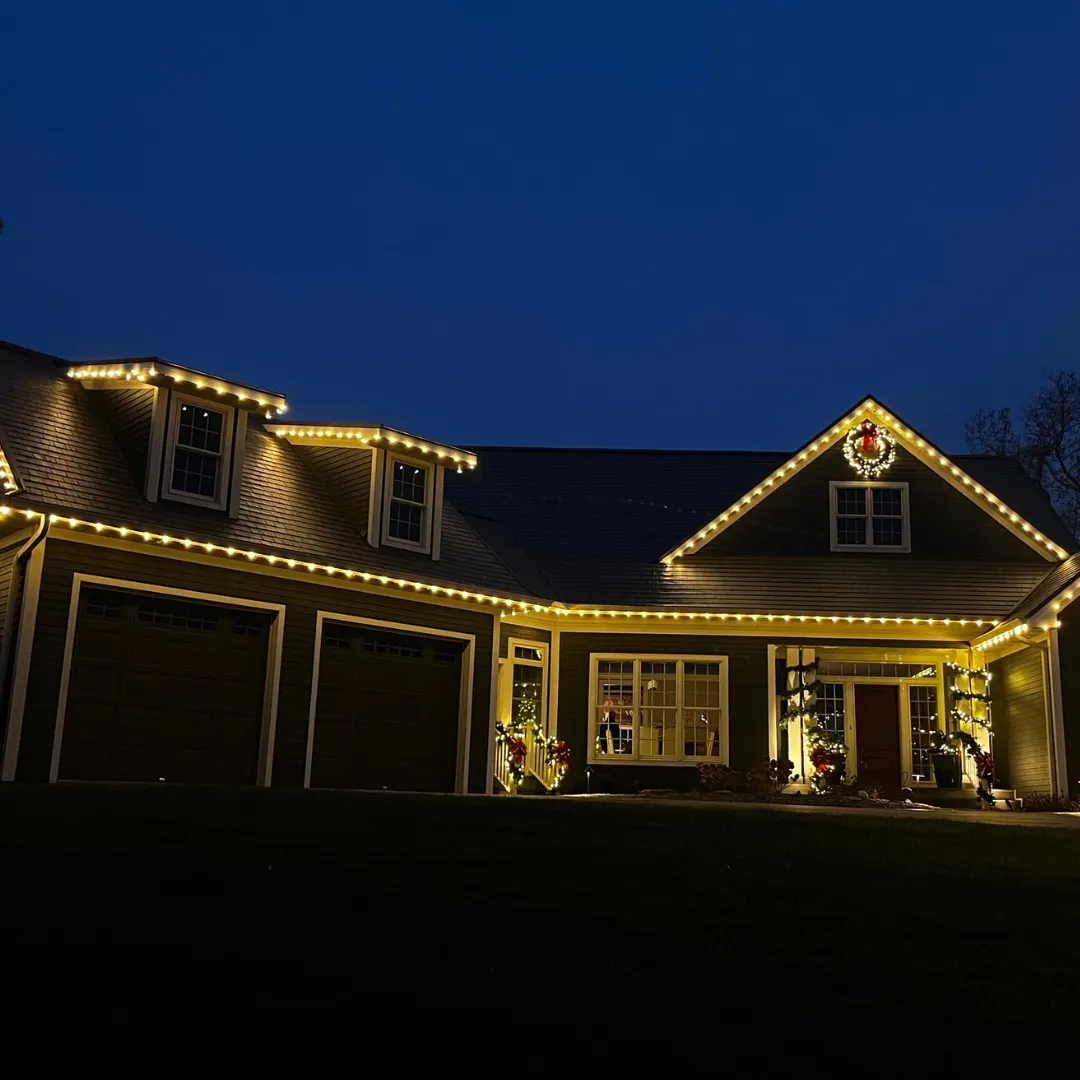
Wreaths, garland on porch posts and railings, lit shrubs and evergreens beside the entry, path lighting. Individually these are small. Together they are what makes a display look finished rather than installed, and they add up. A wreath on the gable and garland on four porch posts is a different quote from a wreath alone. This is the part of the plan where a good designer will suggest what earns its place and what does not, because it is also the easiest place to over-light.
Color, and color changing
Warm white is the baseline. Multicolor on trees and shrubs is generally comparable. Color changing systems, where one installation can be set to different colors through the season and beyond, are a different product with a different price, and a house that wants them is quoted accordingly. If a color changing display is on your list, raise it at the consultation so the plan is built around it from the start rather than added later.
Power and distance
Every run needs power, and where your outdoor outlets are relative to where the lights go decides how much cord, how many connections and how much routing work is involved. A tree fifty feet from the nearest outlet needs a run across the lawn that has to be placed and protected. A roofline with no outlet nearby needs a clean route down to one. None of this is expensive on its own, but it is real work, and a house with well placed outdoor outlets is a slightly cheaper house to light.
It is also where the planning prevents the most common failure. Dividing the display across circuits so that nothing trips on the coldest night of December is part of the design, and it is the reason the crew walks the outlets before they quote.
What is not in the price
Nothing that you would need to add. The price you receive at the consultation is for the whole season: design, custom fit strands built to your house, installation by a licensed, insured, trained crew, a timer set to your schedule, maintenance visits when a bulb fails or a storm rolls through, and removal and storage in January. There is no separate takedown charge, no call out fee for a dark strand, and no storage fee. What you agree to is what you pay.
Comparing quotes
If you are getting more than one quote, make sure they cover the same things. A lower number that excludes takedown, charges for service calls or leaves the strands in your garage is not lower once the season is over. Ask every company the same four questions: is removal included, is maintenance included, is the crew insured, and are the strands custom fit or off the shelf. The answers explain most price differences on their own.
Also compare the product. Retail strands and commercial grade strands look different from the road, hold up differently in wind and cold, and last differently between seasons. A quote built on retail product is a quote for one season.
Where to spend and where to save
If the number comes in above what you had in mind, the answer is rarely to light less of everything. It is to light fewer things well. A single clean roofline run and one properly wrapped tree looks better than a roofline, three trees, garland and shrubs all done thinly. Designers will usually suggest dropping the ground plane or the secondary trees first, because those are the elements that add cost without carrying the display from the road.
The other honest saving is patience. A display can be built over two or three seasons. Roofline this year, the big tree next year, the ground plane the year after. Because the strands are custom fit and stored between seasons, nothing done in year one is wasted, and the plan on file grows with the house rather than starting over.
How to get a real number
Walk your property and count: feet of roofline you would light, gables and dormers, stories, trees worth wrapping and how fully, and what you want on the ground plane. That gives you a rough sense of where you sit above the starting price. Then book the consultation, which is free, and let a designer measure it properly. You leave with a plan, an exact price for that plan, and an install week.
Most people find the exact number is close to what the walk around suggested, and that the conversation about what to leave out is as useful as the one about what to put in.
Why early booking affects the price of the result
It does not change the quote, but it changes what you get for it. Strands are built to your measurements before the crew arrives, and that takes lead time. An early booking gets an install in mild October weather, a first pick of install weeks, and any small settling issues sorted in November when the schedule is quiet. A late booking gets whatever weeks are left and a crew working in colder conditions. Same price, better result, for the cost of a phone call in September.
What to Do Next
Take ten minutes at the end of the driveway with the list above. Then call and have someone come and turn your count into a real plan and a real price. Full service displays start at $899, the consultation is free, and the number you get is the number for the whole season.
Lit Up Taylor's Way designs, installs, maintains and removes holiday lighting across Princeton, Peru, LaSalle, Ottawa, Mendota, Kewanee, Dixon, Peoria and the surrounding communities. Call 815-875-8231 or request your free consultation through the website.