Christmas Lights on Older Homes in Princeton, Peru and LaSalle
Lit Up Taylor's Way • September 18, 2026 • 7 min read
The older streets of Princeton, Peru and LaSalle are full of houses that were built to be looked at. Tall Victorians with wraparound porches, square brick foursquares, Craftsman bungalows with deep eaves, farmhouses that were once outside town and are now three blocks from the square. They have more character in one gable than most new construction has in the whole elevation, and in December they can be the best houses on the street.
They are also the houses where a careless display does the most damage, both to the look and to the building. Here is how a professional approach differs when the house is a hundred years old.
Restraint is the whole design
An older home already has lines. Brackets under the eaves, spindles on the porch, a turret, a bay window, decorative shingles in the gable. The mistake is to light all of it, which turns an elegant facade into a rectangle of dots and hides the very details that make the house worth looking at.
The better approach is to choose two or three lines and let them do the work. On a Victorian, that is often the main roofline and the porch roof, with the turret or the front gable picked out and everything else left dark. On a foursquare, it is the hip roof edge and the porch. On a bungalow, the deep eave line and the porch columns. Warm white, nothing else on the structure, so that the light reads as part of the house rather than something attached to it.
What you leave dark matters as much as what you light. The unlit middle band of a two and a half story house is what keeps the shape legible from the street.
Fragile trim and old fascia
The fascia board on a house from 1905 has been painted twenty times and may be soft in places. Ornate trim is irreplaceable. Old gutters can pull away from the house if leaned on. None of this is a reason not to light the house. It is a reason to light it with clips rather than nails, staples or hooks, to place ladders where the structure is sound, and to know before install day where the soft spots are.
That knowledge comes from two places: the consultation, where the designer is looking at the trim as closely as the lines, and you. Nobody knows an old house like the person who lives in it. If a porch roof gives underfoot or a section of gutter is loose, say so, and the plan will route around it.
At takedown, every clip comes off with the strand. When the crew is finished there should be no trace on the house that the display was ever there, which matters more on original woodwork than on anything else.
Steep roofs and height
Older homes are tall. Two and a half stories with a steep pitch is normal, and the peak of a front gable can be well above where a homeowner's ladder reaches. This is the clearest case for a professional crew. The work is done from ladders positioned properly on the ground wherever possible, roofs are walked only where it is safe to do so, and the crew is licensed, insured and trained for exactly this. A roofline that would be dangerous for a homeowner is a routine morning for people who do it every day of the season.
Height also changes the design. A gable forty feet up reads differently from the sidewalk than one at twenty. Bulbs need to be spaced and sized for the distance, or the line disappears into a faint dotted haze. Larger bulbs on the high lines, smaller ones on the porch at eye level, is the usual answer.
Power: the hidden problem
Houses built before outdoor living was a phrase have few exterior outlets, sometimes one, sometimes none. The wiring behind the ones that exist may be old. This is the single most common practical obstacle on an older home, and it is solved at the consultation rather than on install day.
The designer maps every outlet, checks what each circuit can carry, and lays the runs out so that nothing trips a breaker on the coldest night of December. Where the outlets are not where the lights need to be, cords are routed cleanly and protected. Where a house genuinely does not have the power for the display its owner wants, the honest advice is to have an electrician add an exterior outlet before the season. It is a modest job that makes every future display easier, and the plan can be built around it.
Test your outlets the week before install. Older ground fault circuits trip over the summer and look fine while delivering nothing.
Let the trees carry it
Old neighborhoods have old trees, and this is the great advantage of lighting an older home. A mature oak or maple in the front yard, wrapped from the trunk up into the canopy, can be the entire display. It puts something between the street and the house, gives the display depth, and takes the pressure off the structure so the house itself can be lit with restraint.
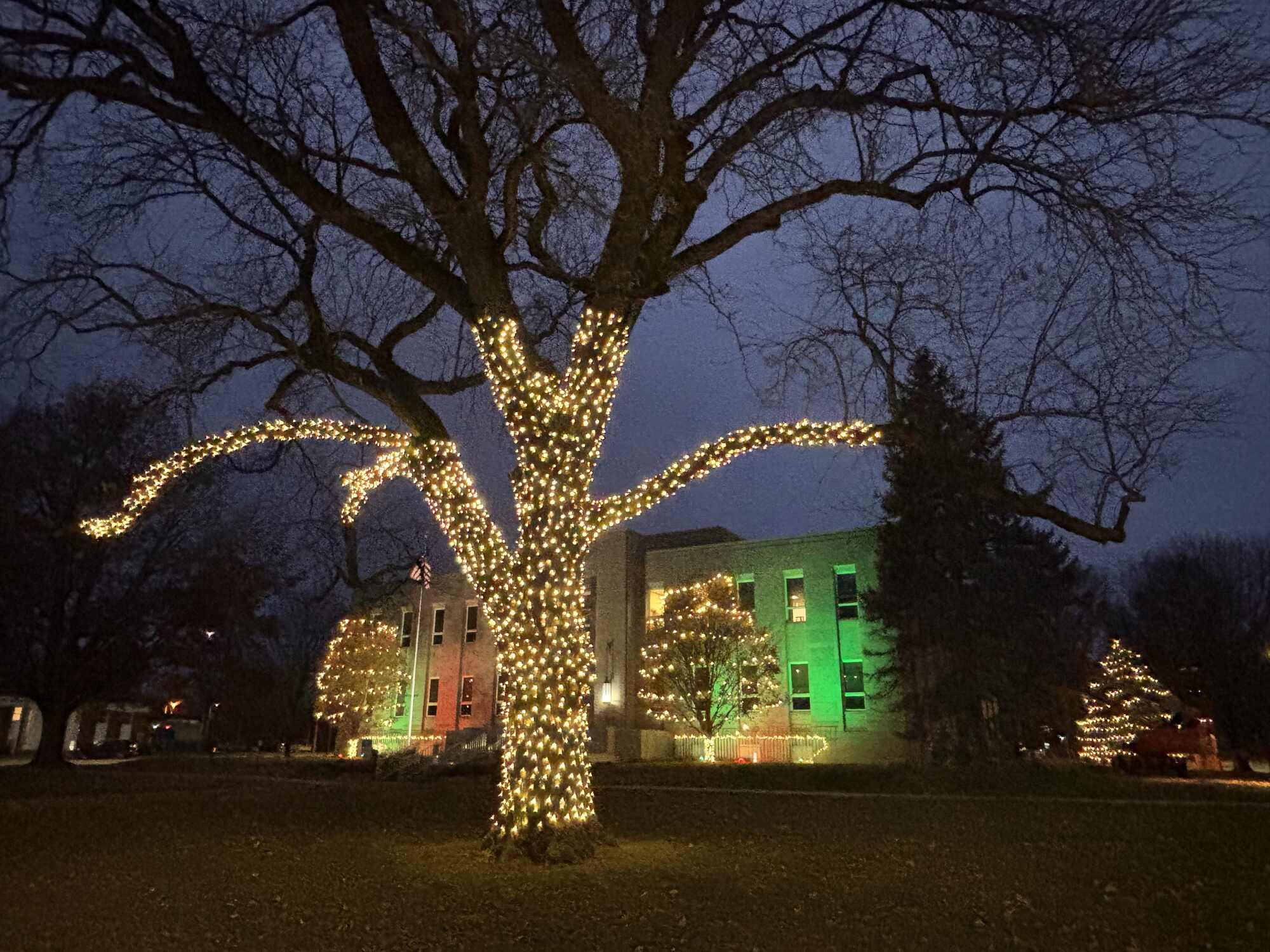
The tree in the photograph at the top of this article is exactly that kind of specimen, a large bare tree wrapped through every branch, with the building behind it lit in color and left otherwise quiet. On a residential street the same idea, warm white in one big tree and a single line along the roof, is how the best older homes in Princeton and Peru are lit.
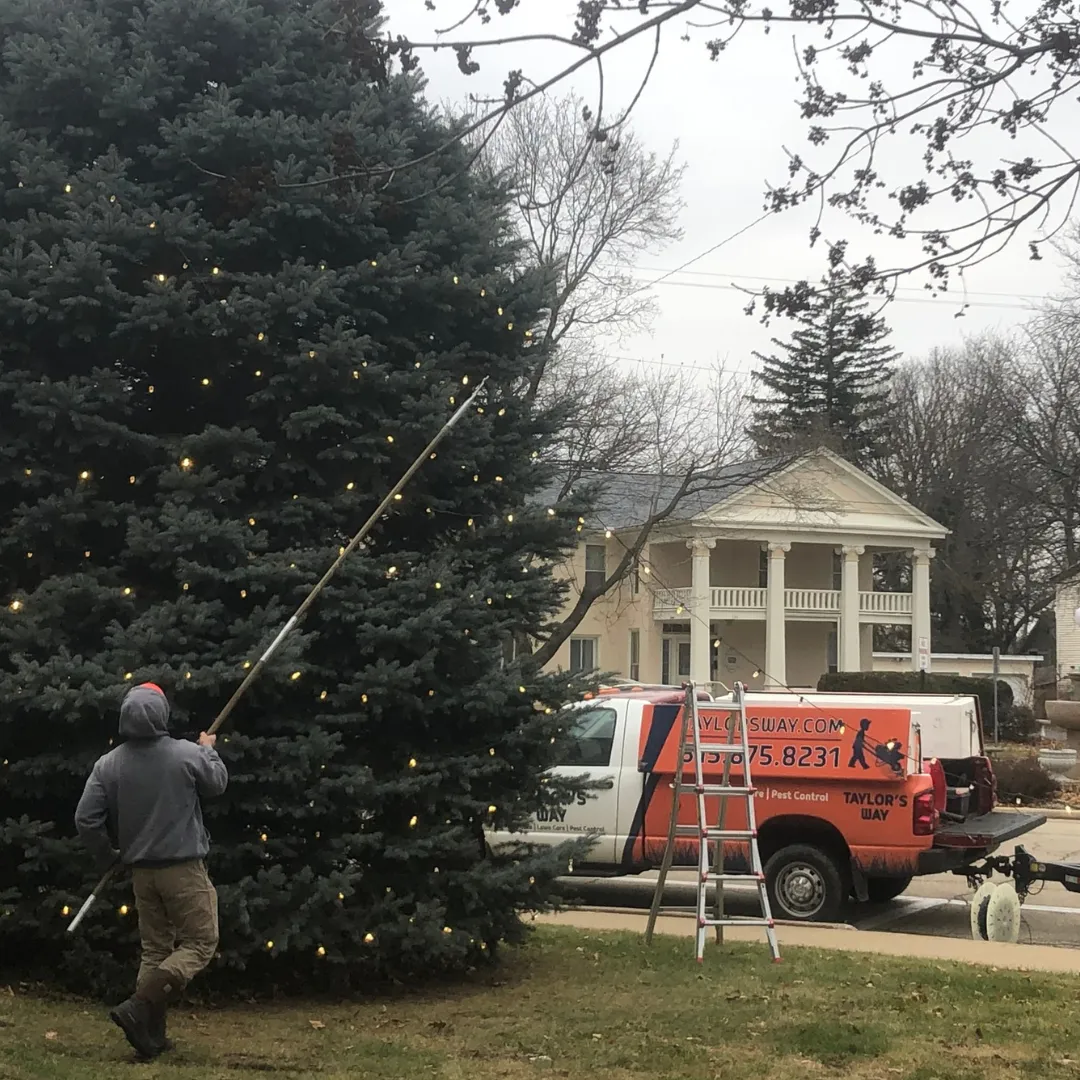
Wrapping is done with the tree's health in mind: strands are not pulled tight against bark, small branches are not loaded, and everything comes off in January with a check that nothing has rubbed. Trees are wrapped with long poles from the ground wherever possible, which is safer for both the crew and the tree.
Brick and stone
Old brick is warm in tone and takes warm white beautifully. It also takes colored uplighting well, washed from below so the wall glows rather than being outlined. On a large brick house or a church, a washed wall behind a wrapped tree can replace a roofline outline entirely and suit the building better. Clips do not go into masonry; runs on brick homes are carried on the roofline, the porch and the trees, never fastened to the brick itself.
Historic districts and neighbors
If your home sits in a designated historic district, it is worth a quick check with the local commission about seasonal decorations. In most places lights are entirely fine and no permission is needed, but it takes one phone call to be sure, and it is better made in September than December.
Older streets are also closer streets. Houses sit nearer the sidewalk and nearer each other, and a lit tree throws light into the neighbor's windows more readily than it would on a wide suburban lot. A switch off at ten or eleven, set on the timer at install, keeps the display up for every hour it is admired and down before it bothers anyone.
What it costs
Older homes are not more expensive to light because they are old. They are priced the same way as any house: feet of roofline, height, number of turns, trees and ground plane. A tall Victorian with a complicated roofline will cost more than a low ranch because there is more roofline and more height, not because of its age. Full service displays start at $899 and include design, custom fit strands, installation, a timer, maintenance through the season, and removal and storage in January. The consultation is free.
What to Do Next
Stand across the street from your house at dusk and pick the two or three lines you would want a stranger to notice. Look at your biggest tree and imagine it lit. Then book a consultation, mention anything you know about the trim, the roof or the outlets, and let a designer turn that into a plan that suits the house you have.
Lit Up Taylor's Way designs, installs, maintains and removes holiday lighting across Princeton, Peru, LaSalle, Ottawa, Mendota, Kewanee, Dixon, Peoria and the surrounding communities. Call 815-875-8231 or request your free consultation through the website.