Roofline, Trees, or Both? Choosing What to Light on Your Home
Lit Up Taylor's Way • September 18, 2026 • 8 min read
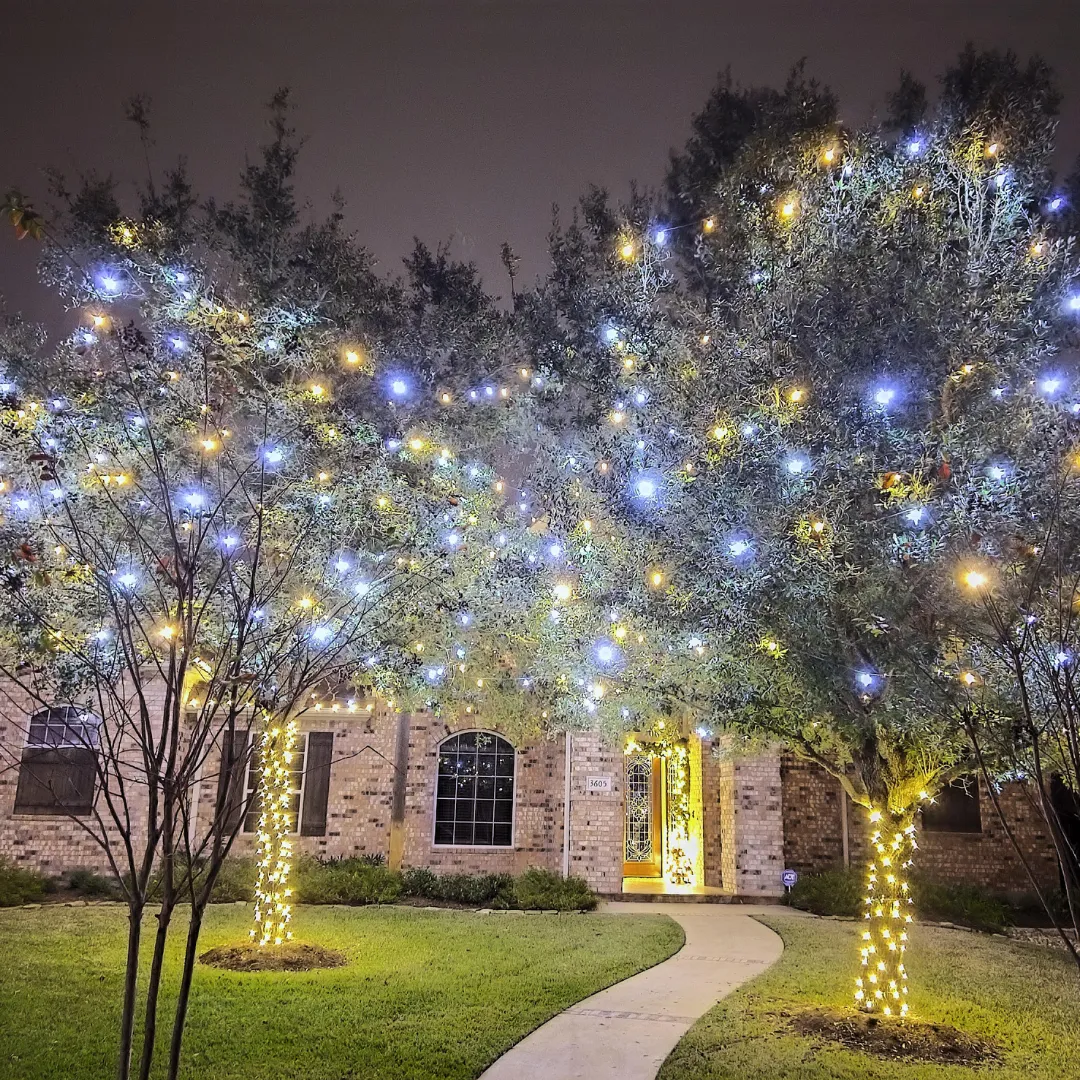
When people first think about lighting their home, they usually picture the roofline, because that is what most displays are. But some of the best displays in Princeton, Peru and Ottawa have almost nothing on the roof at all. They have one or two perfectly wrapped trees and a lit front door, and they stop traffic.
The choice between roofline and trees is not a matter of budget so much as a matter of what your house and your lot are offering you. Here is how to think it through.
What roofline lighting does
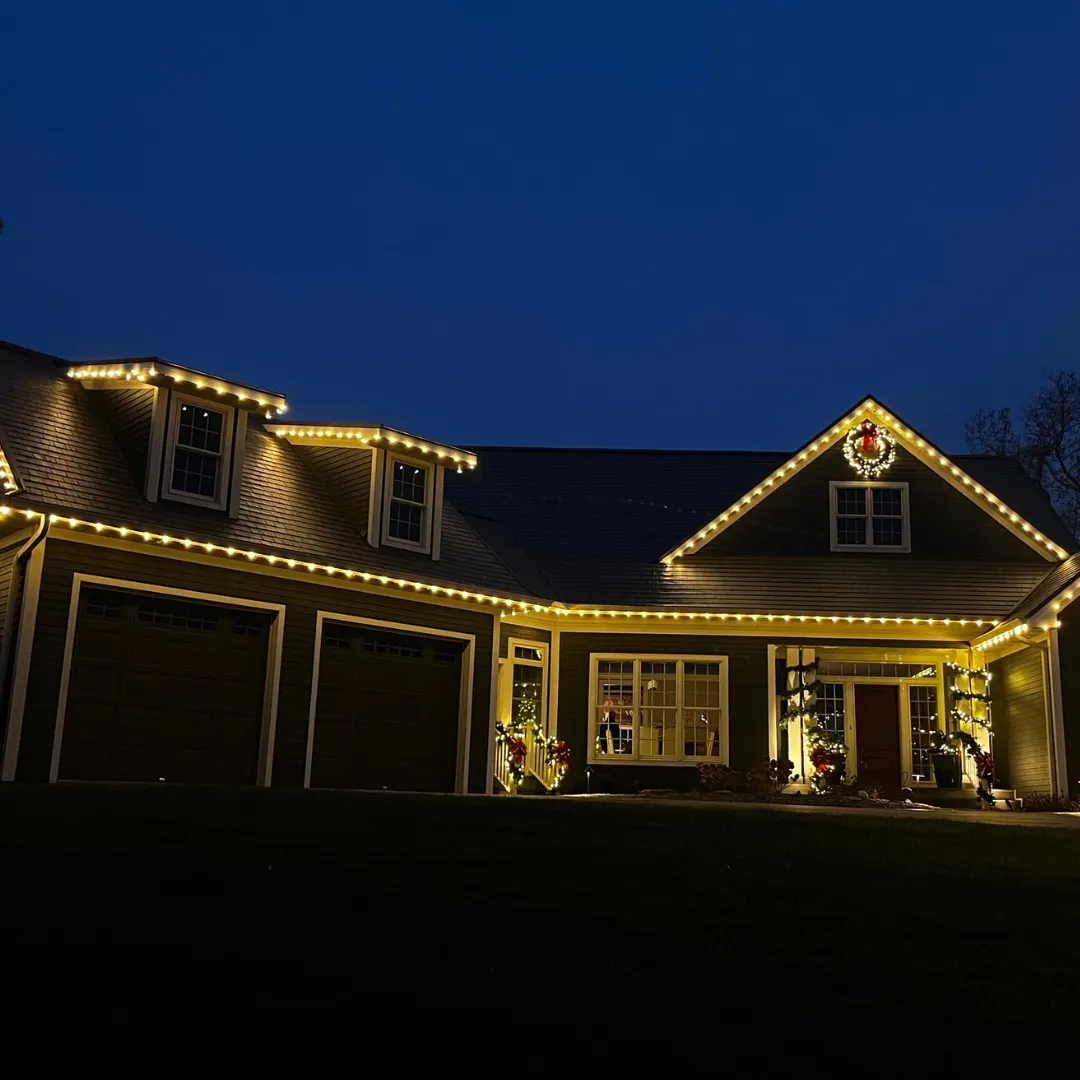
A run of warm white bulbs along the eaves, up the gables and across the dormers does one thing extremely well: it draws the shape of the house against the dark. From the road, at night, at the speed people actually drive past, that silhouette is what registers. The house reads as a house, tidy and complete, in the half second it is in view.
Roofline lighting suits homes with interesting lines. Multiple gables, a porch roof, dormers, a garage set at an angle to the main house: each of those gives the light a place to turn, and each turn adds interest. It also suits homes that sit close to the street, where the whole front elevation is visible and there is not much yard to work with.
Where roofline lighting struggles is on long, plain, single story homes with no breaks in the eave. A hundred feet of straight bulbs is a bar of light, not a house. On those homes the answer is usually to outline the garage and the entry gable separately, and to leave some of the run dark so the shape has rhythm.
What tree lighting does
A wrapped tree is a different kind of object. Where the roofline is a line, a tree is a volume, and it is seen from a different distance. Roofline lighting is for the car going past. Tree lighting is for the car that slows down, the neighbor on the sidewalk, and you, standing at your own front window with a coffee.
Trees also solve the depth problem. A house lit only along the roof can look like a flat cutout, especially if it sits well back on the lot. A lit tree in the front yard puts something between the road and the house, and suddenly the display has a foreground and a background. On deep lots with a long approach, trees are often the only thing that makes a display legible from the street at all.
Trunk wrap or canopy
There are two ways to light a tree and they produce different results.
A trunk wrap spirals bulbs tightly up the trunk and out along the main limbs. It gives a clean, architectural look, works on trees of almost any size, and holds up well in wind because the strands are snug to the bark. On a row of small ornamental trees along a driveway it is hard to beat.
Canopy lighting drapes bulbs through the branches so the whole crown glows. It is fuller, softer, and more dramatic, and it is what people usually mean when they say a tree looks magical. It needs a tree with a real crown to hang the light in, and it is more work to install and remove, which is part of what makes it feel generous.
Large trees often get both: a wrapped trunk carrying the eye up into a lit canopy. That is what anchors a display, and one tree treated that way can do more than the entire roofline.
Which trees are worth it
Not every tree is a candidate. Evergreens, especially spruce and fir, are natural choices because they hold their shape all winter and give the bulbs something to sit against. Bare deciduous trees can be spectacular as canopy work, since without leaves every lit branch is visible, but they need enough structure to carry it. A young maple with three branches does not have anywhere to put the light.
The other test is location. The tree has to be seen. A beautiful spruce at the back corner of the lot, behind the garage, is not worth the labor, however good it would look. The designer is asking one question about every tree on the property: does this sit where the display is viewed from.
When roofline alone is right
Homes close to the street with good architecture and no significant trees. Two story colonials, houses with several gables, anything with a porch and dormers. Here the roofline is the display, and adding trees would compete with it rather than support it. Keep the yard quiet, light the door and a wreath, and let the house do the work.
When trees alone are right
Ranches and other low, plain homes where the roofline has nothing to say. Homes set far back on deep lots. Homes with one exceptional tree in the front yard. Older houses with fragile trim or complicated rooflines that are better admired than clipped onto. In all of these, a wrapped tree or two plus a well lit entry gives a richer result than bulbs along a featureless eave.
When both are right, and how to keep them from fighting
Most homes end up with both, and the mistake is treating them as equals. Two things demanding attention at the same volume cancel each other out. One should lead.
If the roofline leads, keep the trees simple: trunk wraps in the same warm white, no canopy work, no color. If a tree leads, keep the roofline to a single clean run or drop it to just the entry gable, and put any color you want into the tree and the beds around it. The eye should know where to go first.
Do not forget the ground plane
Whatever you choose up high, the display needs a base. Lit shrubs beside the steps, a wreath on the door or gable, garland on the porch posts, a lit path: these connect the roofline or the trees to the ground so the house does not appear to float over a dark yard. It is the part most often skipped and the part that makes a display feel finished rather than installed.
Power and reach change the answer
There is a practical side to this choice that homeowners rarely see but designers always check. Roofline lighting needs power where the runs begin and end, which usually means outdoor outlets near the eaves or a clean route down to one. Trees need power out in the yard, and a tree forty feet from the nearest outlet means a run across the lawn that has to be placed where nobody will trip on it and the mower will not find it in spring.
Neither of these is a reason not to light something. They are reasons the plan looks the way it does. If a tree you love sits a long way from power, the designer may suggest a trunk wrap rather than a full canopy so the load is smaller, or may run the roofline first and bring the tree in the following year once an outlet has been added. Circuits matter too: a display that trips a breaker on the coldest night of December is a planning failure, and the consultation is where it gets prevented.
The other practical limit is reach. Most tree work is done from the ground with long poles, which is safer and gives a more even result than climbing. A tree whose crown starts well above pole height may get a trunk wrap and a lit lower canopy rather than the full tree, and that is usually the better looking choice anyway.
How the decision actually gets made
At a design consultation, this is the conversation. The designer stands at the road, looks at the house, looks at the trees, and asks what you want people to see. From there the answer usually presents itself. What you are paying for is someone who has made this call on hundreds of houses and knows when a plain roofline should be left alone and when one spruce is the whole show.
The consultation is free, and full service displays start at $899, including installation, a timer set to your schedule, maintenance through the season, and removal and storage in January.
What to Do Next
Stand at the end of your driveway tonight and look at the house the way a stranger would. Notice what your eye lands on. That is usually where the light should go, and it is the first thing we will talk about when we come out.
Lit Up Taylor's Way designs, installs, maintains and removes holiday lighting across Princeton, Peru, LaSalle, Ottawa, Mendota, Kewanee, Dixon, Peoria and the surrounding communities. Call 815-875-8231 or request your free consultation through the website.